Research point
For this research point I was asked to look at paintings that focus on domestic interiors.
The first work I looked at was Anthony Greens ‘study for Mrs Madeline Jocelyn with her son’ 1987.

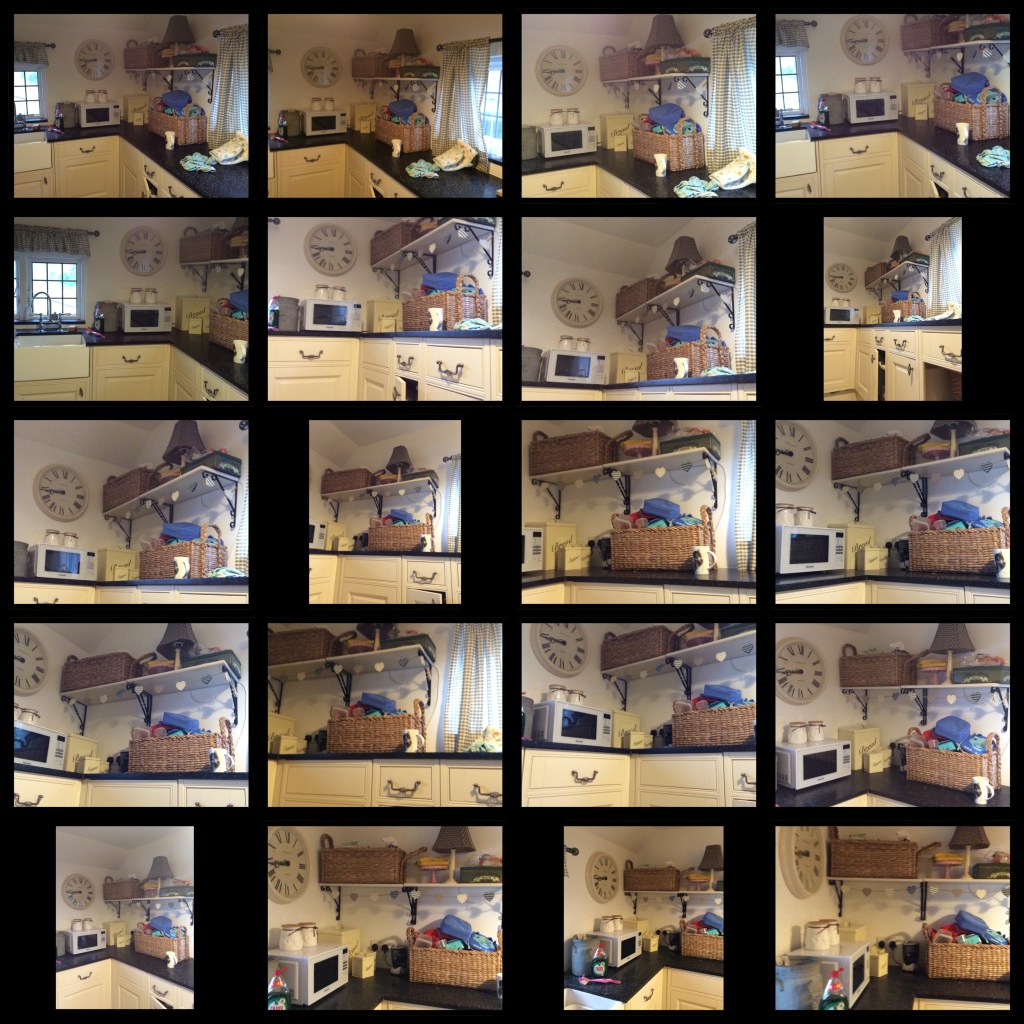
In this image the viewer looks down on the scene and is able to look at the room from many angles. It looks almost like a box has been unfolded and opened to reveal an exciting interior of a living room. Since I began drawing interiors of my house I have realised that in order to include everything in the room it would take me a lot of drawings as drawing just the four corners of my rooms excluded the majority of the room. I feel that this drawing is an exciting and intimate exploration into somebody’s entire room.
I then looked at Van Gogh’s ‘The Bedroom’ -1888, 1889 and 1889, these are paintings of Van Goghs bedroom. They each contain his bed, a windows, a small table, two chairs and a selection of pictures on the wall. It really allows me, the viewer a sense of intimacy into Van Goghs world. I think there is something very personal about somebody’s bedroom, and these images allow me to feel a very personal connection with Van Gogh.

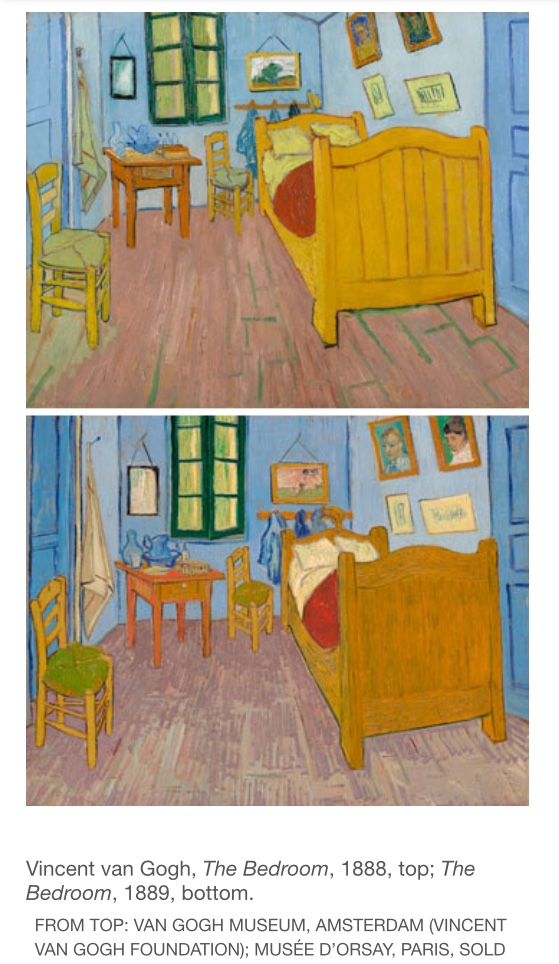
The most fascinating thing about these paintings however are the fact that these three separate paintings of his bedroom in Arles France are actually different.
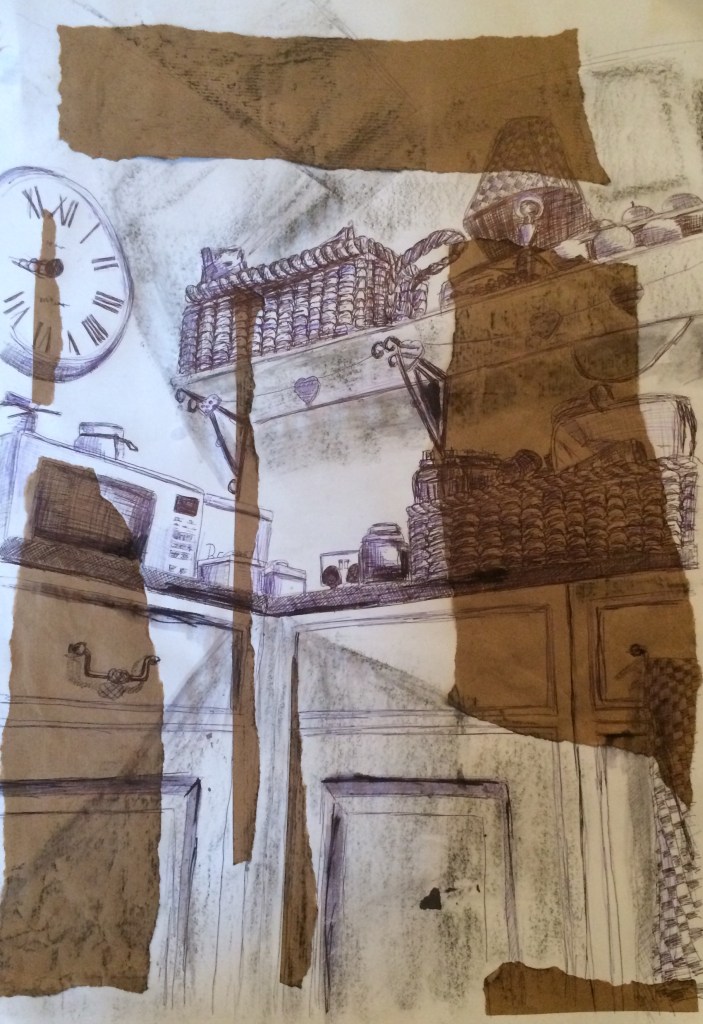
At first glance I thought they were the same painting, however upon further inspection I noticed extremely subtle differences such as different paintings on the wall and different items of clothing on the hooks behind the bed. This reminded me of my own work, especially my kitchen studies where I encountered differences such as my baskets or tins at different angles or food items added or missing. For my work this indicated the passing of time, if only by a few hours or days, but for Van Goghs work that passing of time was across a year and the fact his wall paintings were different shows real decisions of choice, taste and ideals changing over such a short period.
The next artist I decided to look at was David Hockney.
The work I chose to look at is ‘Montcalm Interior with 2 Dogs’ 1988
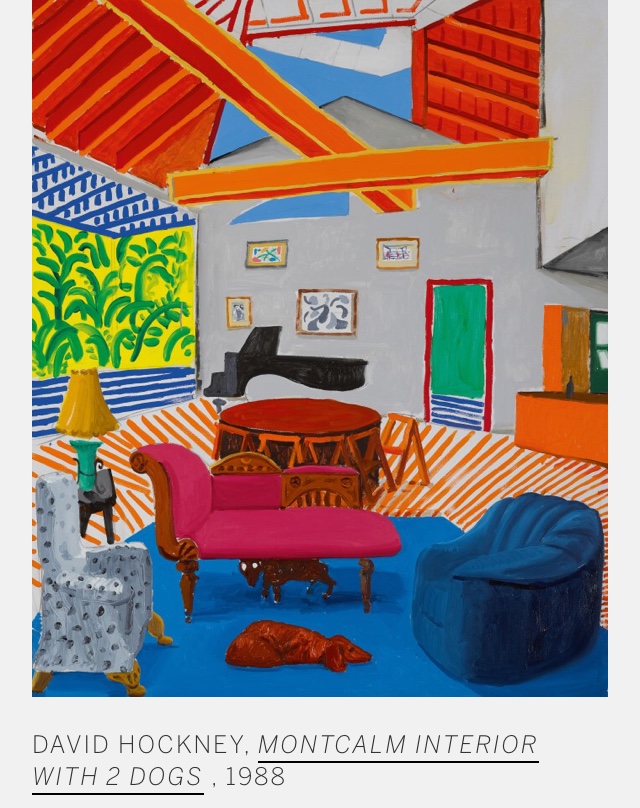
This is a piece of work that was painted after the artist moved from the north of England to California.
I love Hockneys use of bright and vibrant colour in this painting. I am led to wonder if his move to sunny California from the north of England was inspiration for the glorious brightness of this work?
I also love how his bold use of pattern forces the eye to travel all around this piece. I find that the orange stripes on the floor are almost like arrows directing my eye.
I am also fascinated by its compositional structure- the way he has managed to show his very high ceiling and his angular beams along with his triangular high window makes the entire composition very exciting.
I then found out that Hockney actually featured this Californian home in a number of his works.
The other piece that I am going to look at is entitled ‘large interior, Los Angeles’ (1988). It is considered the ‘sister’ painting of ‘Montcalm Interior with 2 Dogs’ 1988.
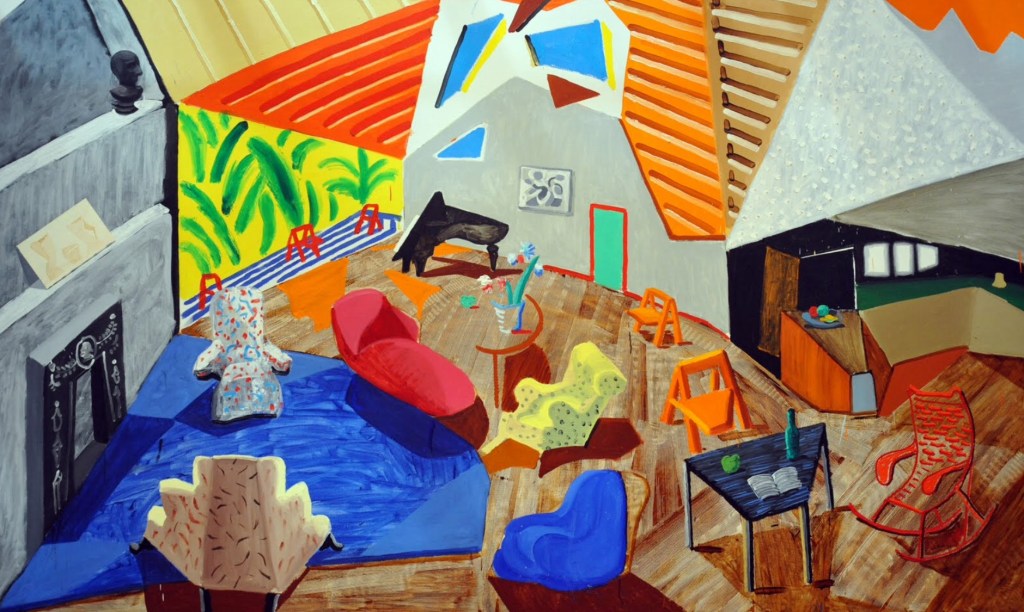
This painting also depicts Hockney’s high-ceilinged living room. However this painting shows his living room from a slightly different viewpoint or angle. It looks at the room from above, from the vaulted ceiling. However it appears that some of the furniture has been moved around (again showing the passage of time just like Van Gogh’s bedroom work.)
Another link I can see with David Hockneys living room and with Van Gogh’s bedroom work is the expressive brushwork and use of bright colour.
Like Anthony Greens study for ‘Mrs Madeline Jocelyn with her son’ 1987. What I find fascinating about Hockneys paintings is how he manages to fit such a large percentage of the room in just one two dimensional painting.
The next piece of work I am looking at is Philip Pearlsteins, ‘male model with kimono, female model with mirror’ 1985.
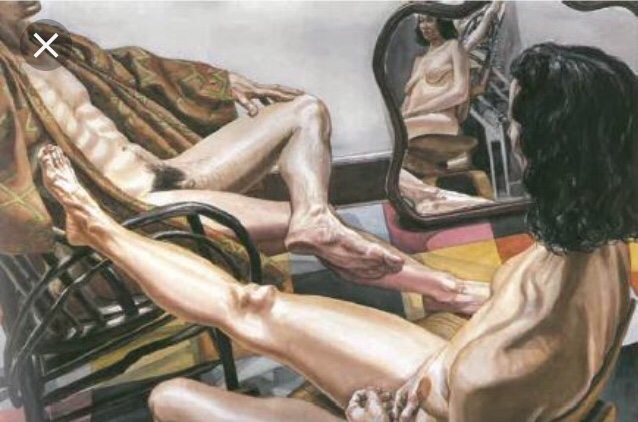
This painting is of male and female nudes sitting in chairs across from each other, the males head is not in the picture and the female has her head tilted so we are unable to see her face. Opposite the female lies a mirror. (For me this is the most exciting part of the painting as it allows me, the viewer to see parts of the image I feel I am not entitled to see. It makes me feel like I am almost inside the room).The mirror also takes the painting away from just being about a portrait of the nudes to being a painting of the interior of the room, through this mirror the viewer not only gets to see the woman from a different angle but also gets to explore the rest of the room or living space.
I love the almost diagonal viewpoint of this painting. Having the nudes positioned on their chairs opposite one another really allows this diagonal viewpoint to be so effective. The mirror also adds a more distanced frontal view of the woman, which just adds to the depth of this painting.
This painting links to both Hockneys work and Pearlstein and Greens work in that it offers more of the room to the viewer than you might originally expect.
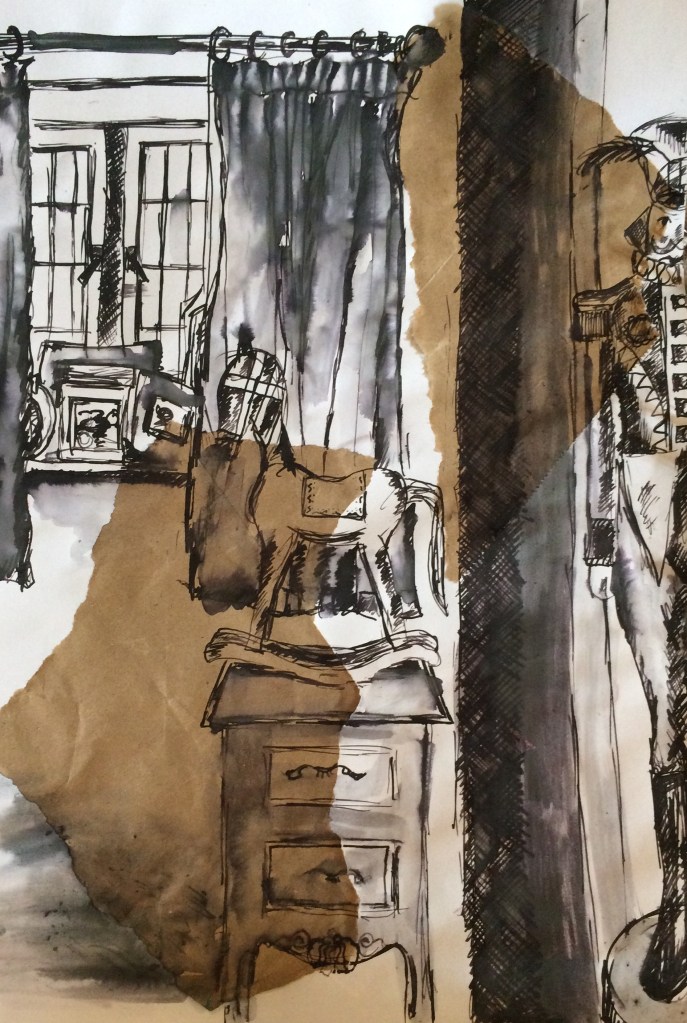
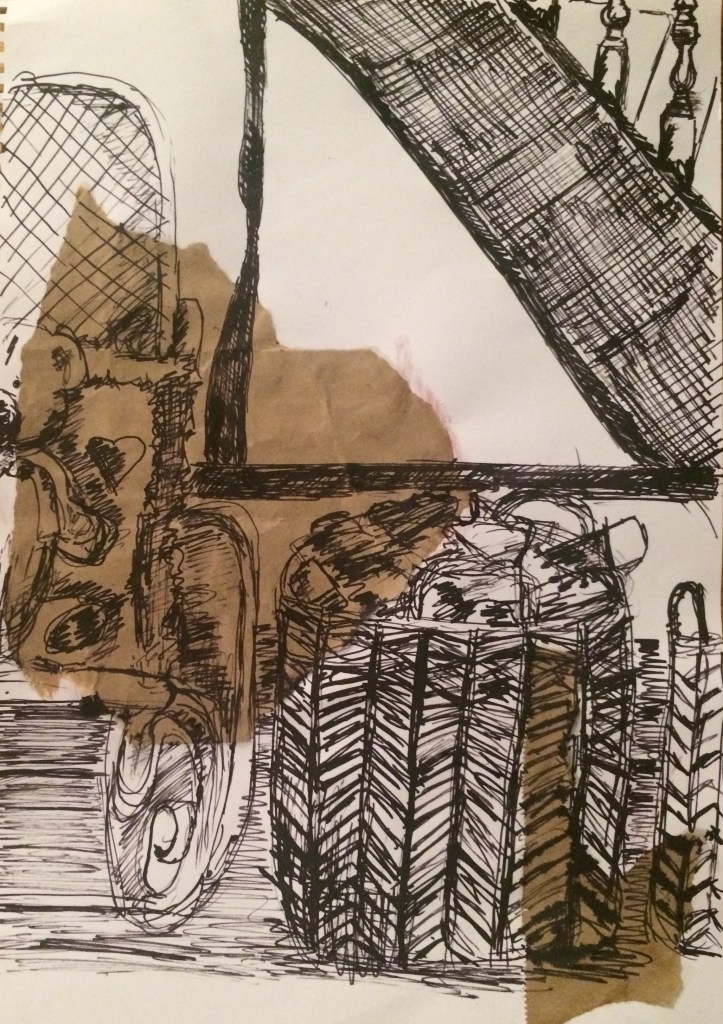
From this research I would really like to experiment with different viewpoints further in my work and try to be more exciting and experimental in my approach to viewpoints.
Bibliography:
Tuchman, P. (2016) Domestic Dreams: ‘Van Gogh’s Bedrooms’ at the Art Institute of Chicago Offers a Rich Look at Three Masterworks. At: http://www.artnews.com/2016/03/14/domestic-dreams-van-goghs-bedrooms-at-the-art-institute-of-chicago-offers-a-rich-look-at-three-masterworks/ ( Accessed11/06/2019).
Tate. (2019) David Hockney Pembroke Studio Interior 1984. At: https://www.tate.org.uk/art/artworks/hockney-pembroke-studio-interior-p20106 ( Accessed11/06/2019).
Sothebys. (2019) A Peek Into David Hockney’s Vibrant Private World. At: https://www.sothebys.com/en/videos/david-hockney-vibrant-private-world ( Accessed11/06/2019).






 Caitriona